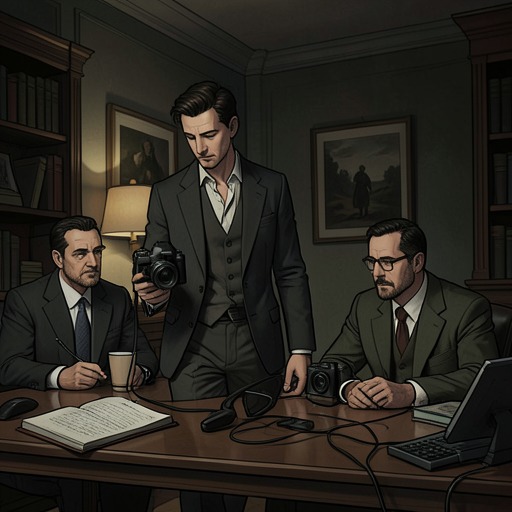
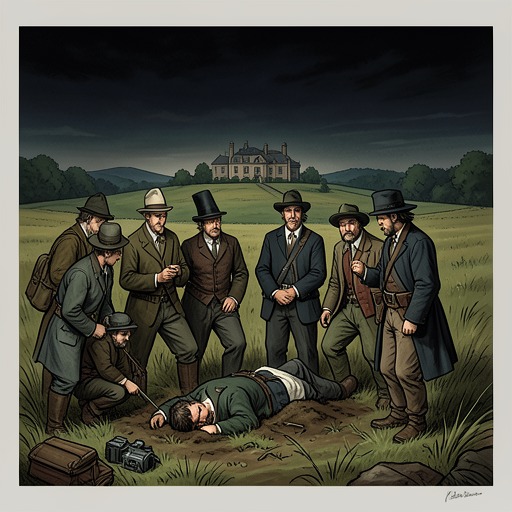
Geiger's body is hidden and returned
The Big SleepGeiger’s body is hidden after he is killed and then returned to a bedroom in his house, a sequence that transforms the scene of the crime before the police can establish what happened. Philip Marlowe first finds the body missing, then later discovers it laid out beneath two strips of Chinese tapestry. He reconstructs the removal and return as an act by Carol Lundgren, whose fear of the police and attachment to Geiger lead him to conceal the body, remove his own belongings, and eventually restore his dead friend to the bed.
The Discovery of an Altered Scene
After being away from Geiger’s house, Marlowe returns in the rain and finds it empty. He unlocks the door, enters the still-warm darkness, and turns on a lamp. The first visible change is on the wall: two strips of embroidered silk are missing, leaving bare patches of plaster. Their absence is an early sign that the room has been disturbed, though it does not yet explain where the body has gone.
Marlowe notices a second alteration near the totem pole. A rug has been placed on the bare floor, beyond the edge of the Chinese rug, where Geiger’s body had been. Geiger is no longer in the bedroom, beneath the bed, in the closet, or in the kitchen or bathroom. A locked room across the hall proves to be a separate, bare masculine bedroom, not the place where the body has been taken. In the living room, Marlowe sees what may be two parallel grooves in the rug, aligned toward the front door, as if heels had been dragged along it. The missing corpse and these traces turn the house into a scene whose evidence has been partly erased and partly left behind.
The Body Returned
Later, after dealing with the young man in the house, Marlowe opens the bedroom across the hall. Its arrangement is changed: two black candles stand on straight-backed chairs beside the bed, and incense burns on a small brass tray. Geiger has been returned to this room. The two strips of tapestry missing from the wall have been laid across him in the form of a St. Andrew’s Cross, concealing the front of his Chinese coat. He lies stiffly on the bed, his arms crossed at the wrists and his hands arranged flat against his shoulders. Marlowe does not touch him or approach closely; he recognizes that Geiger is dead and leaves the room.
The return does not restore the original scene. Instead, it replaces the absence Marlowe encountered with a deliberate arrangement: the body is on the bed, the missing wall hangings now mark it, and the candles and incense make the room appear staged. The change gives the concealment a second phase. Whoever moved Geiger first removed the body from its place and then brought it back, but the signs of handling remain legible to the investigator.
Marlowe’s Reconstruction
Marlowe explains the likely sequence to the authorities while making clear that it is inference rather than established fact. He reasons that Lundgren must have hidden Geiger’s body after Marlowe left to take Carmen Sternwood home. Joe Brody, in Marlowe’s account, would not have entered the house after Geiger was shot; Lundgren, by contrast, had been there and had reason to fear the police. Marlowe supposes that Lundgren dragged Geiger through the front door, perhaps put the body in the garage, and removed his own belongings from the house.
The return, as Marlowe reconstructs it, came later that night, before the body had stiffened. Lundgren may have felt that he had treated his dead friend badly by leaving him hidden, and so carried him back and laid him out on the bed. Marlowe presents this explanation as a conjecture, not a witnessed confession or a fully verified account. His reasoning depends on the rug marks, the altered room, Lundgren’s presence, and the difference between the initial absence and the later arrangement of the body.
Consequences for the Investigation
The temporary concealment changes what Marlowe and the police can know from the house. Geiger’s body is not where it was first left, and the room has been modified; the missing tapestry, the additional rug, and the possible drag marks preserve clues while also showing that the scene has been manipulated. Marlowe’s reconstruction supplies a plausible bridge between those physical traces, Lundgren’s fear of police attention, and the body’s return, but its explicitly speculative status leaves uncertainty about the precise movements and motives involved.
The episode also links the investigation of Geiger’s death to the wider network of concealed evidence and competing explanations. The body’s disappearance is not simply a delay in discovering a corpse: it is an intervention by someone close to Geiger, made under pressure and followed by an act of apparent respect. By separating the murder from the later handling of the body, the novel makes the crime scene itself part of the mystery. The body is both evidence and an object whose placement reflects the conflicted response of the person who moved it.